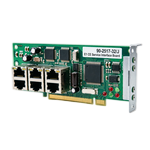
The Alcatel-Lucent 90-2517-32/J E1 CE (Circuit Emulation) is a high-density service interface board engineered for E1 circuit emulation service transport over packet-switched networks (PSN) and optical transport infrastructure in telecommunications access, metro, and core network deployments. This module provides comprehensive TDM (Time Division Multiplexing) to packet adaptation functionality for transporting legacy E1 services over MPLS, IP, or Ethernet packet networks while maintaining strict timing synchronization, low latency, and carrier-grade service quality. The E1 CE card implements advanced circuit emulation protocols including CESoPSN (Circuit Emulation Service over Packet Switched Network) per IETF RFC 5086, SAToP (Structure-Agnostic TDM over Packet) per IETF RFC 4553, and TDMoIP (TDM over IP) specifications for seamless migration of legacy TDM services to modern packet-optical infrastructure. The board features high-density E1 interface ports with 75Ω coaxial BNC or 120Ω RJ-48 connectors supporting structured (Nx64 kbps) and unstructured (2.048 Mbps) E1 modes, timeslot assignment, and channelized operation for flexible service delivery. Advanced features include adaptive clock recovery (ACR) and differential clock recovery (DCR) for precise timing synchronization across packet networks, dynamic jitter buffer management with adaptive buffer sizing to compensate for packet delay variation (PDV), packet loss concealment (PLC) mechanisms, sequence numbering for packet reordering, and comprehensive performance monitoring of packet loss, packet delay, delay variation, and TDM layer parameters including bit error rate (BER), code violations, and frame alignment errors. The module supports integrated timing distribution with synchronization supply unit (SSU) connectivity, building integrated timing supply (BITS) interfaces, and synchronous Ethernet (SyncE) per ITU-T G.8261/G.8262 for network-wide synchronization. The E1 CE card implements sophisticated quality of service (QoS) mechanisms including traffic classification, priority queuing, weighted fair queuing (WFQ), traffic shaping and policing per MPLS and Ethernet specifications, and bandwidth allocation for differentiated service delivery. Integration with the transport shelf backplane provides connectivity to cross-connect matrices, packet processing modules, uplink interfaces (Gigabit Ethernet, 10 Gigabit Ethernet), and system control processors for coordinated network operation. Management interfaces include TL1, SNMP v3, NETCONF/YANG, and proprietary element management system protocols for integration with Alcatel-Lucent's 1350 OMS, 5620 SAM, and third-party network management systems, providing access to E1 port configuration, circuit emulation parameters, clock recovery settings, jitter buffer configuration, performance statistics, alarm status, and diagnostic information including loopback testing and fault isolation capabilities. Power is supplied via −48 V DC backplane distribution with hot-swappable design enabling field replacement without service disruption. Environmental specifications comply with ETSI EN 300 019 Class 3.1 and NEBS GR-63 Level 3 standards, supporting continuous operation in controlled telecommunications facilities with ambient temperatures from 0 °C to +45 °C and relative humidity up to 95% non-condensing. The E1 CE is validated for deployment in Alcatel-Lucent 1650SM/1660SM/1670/1696MS/1830/1850 series transport platforms and related optical transport and packet-optical systems, and ensures compliance with ITU-T G.703, G.704, G.707, G.823, G.826, G.828, IETF RFC 4553 (SAToP), RFC 5086 (CESoPSN), RFC 5287 (Control Protocol), IEEE 802.1Q/802.3, MEF specifications, ETSI EN 300 417, and Telcordia GR-63/GR-1089 standards for carrier-grade E1 circuit emulation service delivery over packet-switched and optical transport networks.